100 years have passed since the First Turkological Congress held in Baku in 1926. The Order of the President of the Republic of Azerbaijan Ilham Aliyev dated October 22, 2025, “On holding the 100th anniversary of the First Turkological Congress” opens up great prospects for further expanding and developing the mutual relations of Turkic peoples, who share common historical roots and national-spiritual values.
Studying the historical lessons of the Congress, preserving its traditions, and passing them on to new generations is relevant for the modern era. In connection with the execution of the Head of State's Order, an extensive plan of events has been prepared and is being implemented at the Ministry of Culture, the Ministry of Science and Education, and the National Academy of Sciences.
Modern.az reports that an international scientific conference on the topic “Founders and Lessons of the First Turkological Congress: History and Modernity” will be held on February 27-28 in the Grand Assembly Hall of the Azerbaijan National Academy of Sciences on Istiglaliyyat Street.

Baku recognized as a scientific center since the early 20th century
A hundred years ago, the First Turkological Congress was also held from February 26 to March 6 in the same Grand Assembly Hall on Istiglaliyyat Street – in the current building of the Presidium of the Azerbaijan National Academy of Sciences. As noted in the Order “On holding the 100th anniversary of the First Turkological Congress,” the city of Baku hosted the First Turkological Congress because it was distinguished by a high level of intellectual life from the beginning of the 20th century and was recognized as one of the influential centers of world Turkology. The fact that the first mass application of the new alphabet among Turkic republics began precisely in Azerbaijan was the result of the consistent struggle for alphabet reform waged by progressive intellectuals here since the 19th century.
Unfortunately, the vast majority of the Congress delegates were subjected to the repressions of the 1930s. Only the national independence gained at the end of the last century illuminated the paths of spiritual revival for Turkic peoples, once again actualizing the implementation of a common Turkic alphabet with Latin script among important issues.
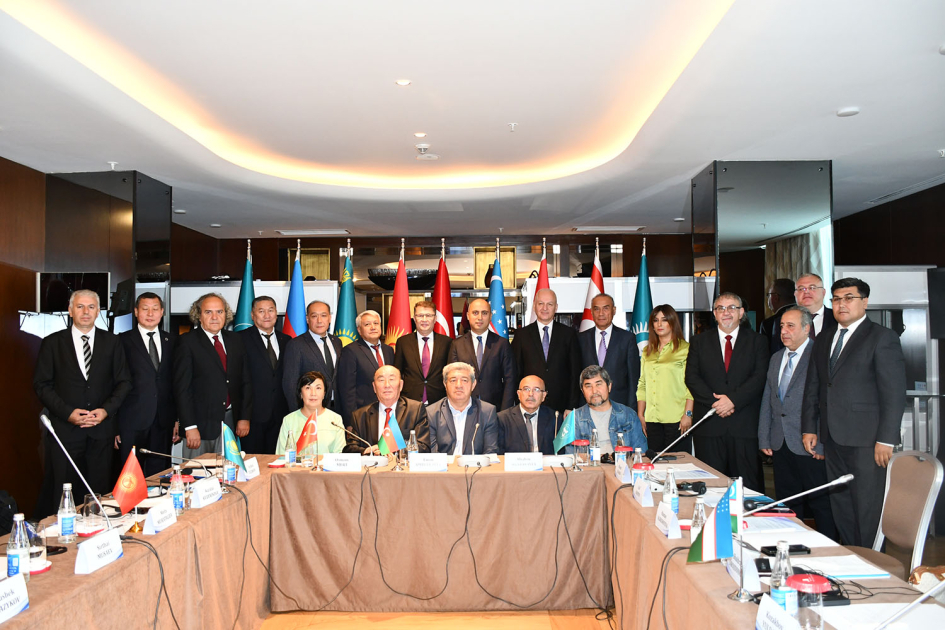
Main scientific ideas and adopted decisions of the First Turkological Congress
131 prominent linguists, literary scholars, historians, ethnographers, renowned poets, and writers from Azerbaijan, Turkey, Central Asian republics, Georgia, North Caucasus, Tatarstan, Bashkortostan, Altai Autonomous Republics, and Yakutia participated in the First Turkological Congress. Within the framework of this important event, 17 sessions were held. 38 reports related to the language, history, ethnogenesis, ethnography, literature, and culture of the Turkic world were presented at the sessions. Issues of common history, literature, terminology, orthography, and ethnography were discussed at the Congress, and the foundations of Turkology as a science were laid.
On February 29, 1926, the First Turkological Congress adopted a historic decision regarding the transition of Turkic peoples to a unified Latin alphabet. In addition, discussions were held and relevant decisions were adopted concerning the spelling-orthography problem, the terminology issue, the teaching-methodology issue, the problems of mutual relations and interference of related and neighboring languages, the literary language problems of Turkic languages, including the issue of a common literary language, the Proto-language theory, and the historical problems of Turkic languages.

Relevance of Congress ideas in the modern era
The First Turkological Congress is a bright page in the scientific and cultural life of Azerbaijan and the entire Turkic world in the 20th century. It is no coincidence that the ideas of the Congress held a hundred years ago are relevant today. As emphasized in the Order of the President of Azerbaijan, many ideas put forward by the First Turkological Congress are being successfully implemented in modern conditions. Remarkable achievements have been made towards the re-formation of the Turkic world as a single family. Decisive steps taken towards strengthening allied relations in the spirit of brotherhood and deepening mutual cultural cooperation among Turkic countries are now of a continuous nature. The reflection of the call to celebrate the 100th anniversary of the First Turkological Congress in the Declaration of the 12th Summit of the Heads of State of the Organization of Turkic States, held in Gabala on October 6–7, 2025, is another manifestation of this.
It should be recalled that the 80th and 90th anniversaries of this Congress were also celebrated at a high level based on the relevant orders of the President of Azerbaijan.
Modern Turkological directions
The 100th anniversary of the First Turkological Congress also creates new directions for young Turkologists. The general history and structure of Turkic languages can be investigated today with new methods, and modern technologies can be applied to Turkology. Young people can create Turkic language corpora through artificial intelligence.

First poetry anthology prepared based on a common Turkic alphabet
The first poetry anthology prepared based on a common Turkic alphabet has been published at the Nizami Ganjavi Institute of Literature of the Azerbaijan National Academy of Sciences. In the anthology titled “Azerbaijan and the Turkic World: Poetry in a Common Alphabet,” historical and modern literary relations between Azerbaijan and the Turkic world are presented through poetry samples in a common alphabet. The 34-letter common Turkic alphabet with Latin script used in the publication is based on the final decision adopted by the Turkic World Common Alphabet Commission, led by the International Turkic Academy, at a meeting held in Baku in 2024. (AZERTAC)