Iqbal Aghazade: "The President has fundamentally solved the problem inherited from Peter I"
“A new era will begin in Azerbaijani politics”
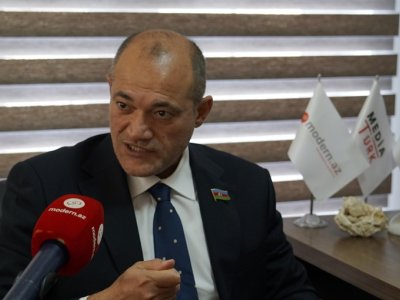
Iqbal Aghazade, chairman of the Umid Party, is known for his outspoken stance on domestic politics, parliamentary activity, and changing geopolitical dynamics in the region.
In this interview given to Modern.az, he answered our questions regarding current political processes, government-opposition relations, socio-political reforms, and prospects for the upcoming period.
We present the interview with the chairman of the Umid Party.
- Mr. Iqbal, why is there no activity in Azerbaijani politics?
- When the national movement began in 1988 and transitioned into the party-formation stage, the primary slogan political parties fought for was “There is no Azerbaijan without Karabakh!” and people were ideologically focused on this national problem. If we pay attention, we will see that in all elections, situational rallies, or events and meetings, the Karabakh problem was consistently discussed, meaning national problems were at the forefront.
With the 44-day Patriotic War that began on September 27, 2020, and the anti-terrorist measures carried out on September 19–20, 2023, a problem that had become the ideological and struggle tactic and strategy of political parties for 30 years was fundamentally resolved. The resolution of a two-century-old problem effectively opened a very significant path towards freeing the South Caucasus from Russia's grip, creating great hope.
The ideology of reclaiming our lands, which political parties had used for years in their interactions with people, belonged to all parties. No party remained outside of this. The ruling party built its ideological propaganda on this, and opposition parties formed their positions on it. Over time, everyone suddenly began to search for a new center for the population and political organizations. After the full restoration of sovereignty and independence, it became necessary to give different, new messages to the electorate, and the electorate began to consider receiving these messages in a different way.
Therefore, neither the electorate nor, in a broader sense, the majority of political parties are yet ready for this process. Various opinions can be expressed regarding the electorate. But there was a problem that society accepted from a social, ideological, and purely auditory and perceptual point of view – and that has been resolved.
Now, whatever you tell the voter, they still need to form it in their ideology. The main factors conditioning political activity are not currently present.
On the other hand, against the backdrop of recent events, serious cataclysms occurred in the vast majority of countries fighting for democracy and universal values. The processes taking place in Ukraine, Arab countries, Moldova, Georgia, Armenia itself, and other countries demonstrated this.
All of this forced the electorate to ponder the issue of democracy and universal values, which coincided with the main topics after Karabakh. Do the events indicate that the struggles for democracy in Ukraine, Georgia, Armenia, or Arab countries truly yield the expected results? Perhaps it is necessary to approach this issue with assumptions in a slightly different direction, or to wait for the world order to enter a new phase? All these factors are generally reasons that reduce political activity.
There will, of course, be a next stage in the political landscape. After the resolution of these types of problems, the second main issue that comes to the fore is the resolution of social problems, in the direction of fighting for democracy, for universal values, and for the ideological formation of political parties.
Positions somewhat closer to social issues will form the main line and program of politics.
- What will this lead to?
- Political parties must cease to be slogan parties. The vast majority of parties were precisely slogan parties. Currently, being a slogan party is not in line with the order of society. Now, it is necessary to build a concrete program.
In January 2024, the Umid Party presented a new program to society. I should note that it is not easy to act from the position of a program party rather than a slogan party. Therefore, not many political parties will remain in Azerbaijan. The new era can also be called the stage of the formation of the political spectrum of parties. As we mentioned, the common ideology of all parties – the former Karabakh problem – has been resolved. My article has also been published: A new era will begin not only in Azerbaijan but also in Azerbaijani politics. This may be late. But it will happen.
The stage of the Azerbaijani voter being ready for this also takes time. The gratitude of our people is a delaying factor. The voter thinks that Karabakh has been taken. The resulting satisfaction leads to stagnation. The era of building ideological states in the world is over. An alternative inevitably emerges to an ideological system. However, the legal system is unified and has no alternative. Now, legal states are being built in the world.
It is also necessary to rely on modern, international law. Historical legal structures do not resonate with modernity. They have taken a form mixed with ideology. In the model of a legal state, everyone's rights are recognized.
As the Umid Party, we are fighting for the establishment of a legal state. For a structure where the rights of every member of society are recognized and the state's rights are not infringed upon.
- How many party members do you currently have?
- More than 58 thousand people.
- What are the main features that distinguish the Umid Party from other opposition parties...
- We were always committed to the state in all periods and prioritized the issue of the state. Even when defending universal values, we emphasized the state's strength as a primary condition. We approached processes with goodwill, never with an adversarial stance.
In all periods, we viewed those in power and in opposition only as rivals. Not as enemies, but precisely as rivals, and we did not allow sharp barriers to be drawn. Today, society is rapidly moving in that direction, and we are glad that we paved this path. For years, when we emphasized the principle of reconciliation and goodwill in political relations, there were those who approached us with irony.
It is 2025, and now everyone talks about reconciliation, about the system of relations; the path we presented back in 2006 is already visible. In the 2008 presidential elections, we demonstrated the first culture. At that time, we were a real opposition candidate. The US State Department also recognized the Umid Party as an opposition organization in parliament.
During that period, we adopted such a humane approach. We wished the President success in his activities and noted what should be taken into account in the future.
- Is there any international cooperation?
- We have relations with international diplomatic corps in all spheres. But today there is a different picture in the world itself. If the United States of America declares today that democracy is the internal affair of every country, and will not negotiate with any countries at the table for democracy, then the conditions have changed. That is, the perspective of diplomatic corps has also changed. We also believe that democracy is the internal affair of every country. But if democracy is a universal value, everyone should be involved in it and it should be investigated at an international level.
- In your opinion, why can't the opposition lead society? In other words, why doesn't society believe the opposition?
- Do you think they follow the government? Here a question arises: when referring to the government, are all individuals meant, or Ilham Aliyev? If it's about Ilham Aliyev, the people accept him. Because Ilham Aliyev fundamentally solved a 200-year-old problem, the people are behind him today. The President has fundamentally solved the problem inherited from Peter I. He has transformed Azerbaijan into a strong state, making it a voice in the international arena. The world now reckons with Azerbaijan. But bring out the individuals representing the New Azerbaijan Party, and at the same time, the deputies in the National Assembly, before the people. See who will support them?
The issue is something else. The issue is that there are no political organizations yet that articulate people's desires. To see who is who, it is absolutely necessary to go to democratic elections.
- AXCP and Musavat functionaries consider only themselves to be the real opposition in the country...
- I cannot say anything to people based on their thoughts about themselves. One might consider himself "God," another might call himself a poet without being able to write poetry. What should I say?
- What is your message to those who call opposition parties that engage in dialogue with the government "bus opposition"?
- This was Ramiz Mehdiyev's statement. We, members of the Azerbaijani opposition, only went to Karabakh by bus. We had no other place to go by bus. It was natural for us to go by bus during that period. Because we were moving according to a program. There was no permission to go to Karabakh by private car, and we moved along a specific route. We needed our homeland; we were ready to go there even by horse cart. The 30-year longing was coming to an end.
- Mr. Iqbal, you are originally from Fuzuli yourself. Would you move and live there?
- I was born in Baku and studied here. Sometimes we see Azerbaijan as large. Azerbaijan's territory is small. We don't travel great distances to reach any district. For me, every part of Azerbaijan is home. I would stay in Qazakh, or in Astara. There is no difference.
Here, the issue of conditions and work schedule is important. The main thing is the work environment. As for territory, or district, it has no significance.
- What is lacking in the opposition for it to be an alternative to the government?
- The very weak state of democracy and political institutionalization in Azerbaijan. If these were present, everything would eventually fall into place. The main problem, however, is the unsatisfactory legislative framework for the formation of political institutionalization.
- In your opinion, what political reforms are needed in the country today?
- There is a great need for political reforms. First and foremost, there is a need for constitutional reform. As I just mentioned, the formation of a legislative framework that defines the functions, place, and role of political institutions in society is imperative.
The mechanism for political parties to come to power should be reflected in the legislative framework. In Azerbaijan, one can participate in elections as an individual. But then, what is the function of political institutions? Improvements should be made in the legislative framework to strengthen the functions of institutions.
On the other hand, the role of certain posts in the governance mechanism must increase. The role of municipalities must increase. The role of parliament must increase, and there must be accountability. Today, there is a section in parliament called the Disciplinary Commission. The commission can write an opinion about a deputy. The Central Election Commission can also deprive him of his mandate. That Central Election Commission, which the National Assembly formed from individual persons. In such a situation, institutionalization is not possible.
In short, if the mechanism for coming to power is not simplified, it will be very difficult.
- There is a common belief in society that the opposition should take a tough stance against the government.
- It's a wrong idea. The government is not an enemy for us to draw shields. Those represented in power are Azerbaijanis who represent our country on the international stage and organize governance domestically. Why should I speak with "sword and shield" my whole life? If necessary, we will sit at the table with them and discuss issues. A professional political stance is to focus on the problem itself. In this process of viewing, you can be tough or soft with the opposing side.
Politics is not a fight. If politics is diplomacy, its door should always be open.
- So, even if the current government has no serious shortcomings, are you in favor of a change in power?
- Presidents in countries around the world are not changed because they are bad. No. They can also provide good service. The point is that change is necessary to prevent stagnation. Mechanisms for coming to power should be functional. Let's look at the Azerbaijani government. How many adjustments are made to the structure. They solve one problem, and other problems emerge. This is the result of a lack of renewal. For example, if the responsibility of executive heads were transferred to municipalities, many of these problems would have been prevented.
Historical experience shows that even the best-performing governments have thirty percent opposition. Do we have thirty percent opposition in our parliament?
- You mentioned that if necessary, one should talk with the government at the table. What proposals would you make to the government?
- We have already submitted our program to the government. After the 44-day Patriotic War, we stated what we want to see and how. We have made our proposals regarding human rights, electoral reforms, and constitutional reforms. A question might arise: what if you have submitted them, does the government implement what you say? If the government implemented all of my proposals, why would it be the government?
If our mission is to make proposals, then its authority is to analyze the proposals and accept those that are beneficial to society, the government, and the state.
- Why are our youth distant from politics?
- Let's not say youth, unfortunately, our society is distant from political processes. There is a wrong perception about youth. It was that youth who liberated Karabakh. When necessary, they will also speak their minds on the political stage. When there is a period of political activity, the youth will definitely be there.
- Is there a young person in your organization who could replace you?
- Many. We have as many young functionaries in our party as you could wish for. They are active on social networks, guide opinions, and express views. There is no other opposition party in Azerbaijan that speaks as much as we do in the mass media in this sense.
- What are your expectations regarding relations with Armenia in the coming year?
- I expect the signing of a peace agreement. And I very much want the concept of a South Caucasus union to come to the fore. Because the world approaches us not from the context of Azerbaijan, Georgia, and Armenia, but precisely from the context of the South Caucasus. A South Caucasus Union should be established in the model of the European Union. This could protect us from external influences and also bring benefits in terms of internal democratization. At the same time, it would be a very advantageous model economically. Azerbaijan's importance here is special. Because our population is larger than that of Georgia and Armenia. This would also be a very appropriate organization for our return to Zangazur. For the unity of Turkic peoples, this would play a bridging role. I don't want to talk much about this in the press yet.
- So, it seems you no longer see a risk of conflict in the region...
- The risk of conflict is not visible. If there is no Russian factor in the region, there is no probability. This could be possible with Russia's influence.
- Mr. Iqbal, what do you think about the "Ramiz Mehdiyev case"?
- The investigation should think about the "Ramiz Mehdiyev case", why should I?
- But could you also be accused of secret cooperation with Ramiz Mehdiyev?
- No, no one can do that. I am precisely one of the people who will not be accused regarding the "Ramiz Mehdiyev case." I have never met Mehdiyev in my life, and while he was in office, I published four articles against him. These are articles I wrote in 2009, 2010, 2012, and 2014. I had no personal issue with him; I wrote about shortcomings. However, in the current situation, if someone is brought under investigation on charges of treason against the state and homeland, this is a very serious matter. Whoever has betrayed Azerbaijan should be punished in the harshest possible way. At the same time, I am against bringing anyone under investigation whose name is not associated with treason. According to the principle of presumption of innocence, no one can be called a criminal before the outcome of the investigation is known. Therefore, I await the conclusion.
- You participated in the elections for the 6th convocation of parliament, but the results of your constituency were annulled. Could Ramiz Mehdiyev have been involved?
- The reason for this was a violation of the law, and it was the first time in Azerbaijan's electoral history that the results of all polling stations in a constituency were annulled. In fact, an injustice was done to me. I had won those elections. I have official protocols in my possession. We disseminated both the video version and the paper format of those protocols as evidence on social networks. Drawing a line through our clear victory was a fault of the Central Election Commission and the government.
- How are your relations with Rauf Arifoglu, who was your main rival in those elections, do you speak?
- No.
- Do you have a red line that you have set for yourself in your activities?
- Many. A person lives in a family, in society. This determines the red lines. Our biggest red lines are upbringing, ethics, loyalty to the state, not infringing on the interests of society, and most importantly, justice.
- Is friendship possible in politics? If so, who are your friends?
- Of course, it is possible. Sometimes people look at politics as if they are looking at something disgusting. I have no enemies in politics. Everyone is my friend.
- Which of your actions have you considered a mistake for yourself?
- Society will evaluate that. I do not believe I have made any mistakes before the state, homeland, or society. From someone else's perspective, I might appear wrong. But in my political activity, I have been correct towards my society, my state, my work, and I have never made a mistake.
- If you were in power, which three amendments would you implement first?
- Firstly, I would amend governance. Secondly, there should be major reforms in Azerbaijan's judicial and legal system. Thirdly, I would elevate the system of relations to a new stage. We need softer relations. Here, the discussion is about the relationship between government-society and political institutions.
- In our political arena, do you see individuals or the political system as the main problem?
- The issue is not with individuals, neither in governance nor in opposition. If you pay attention, when approaching power, individuals have changed in all periods and at all stages, but the problems have not changed. The problems have either remained in place or have been roughly the same.
Therefore, the issue is with the system. The same process has occurred within the opposition: people have changed, some have left, some have come, but the methods and approaches of struggle have not fundamentally changed. This is also a systemic problem. The role of the slogans and main approaches I mentioned earlier is significant in the formation of the system.
There is a necessity for institutions to fall into the right course. As I said, new political programs and real slogans stemming from them should be the regulating factor.
We see that the government is also trying to renew the system. It breaks taboos, brings the untouchables before the law.