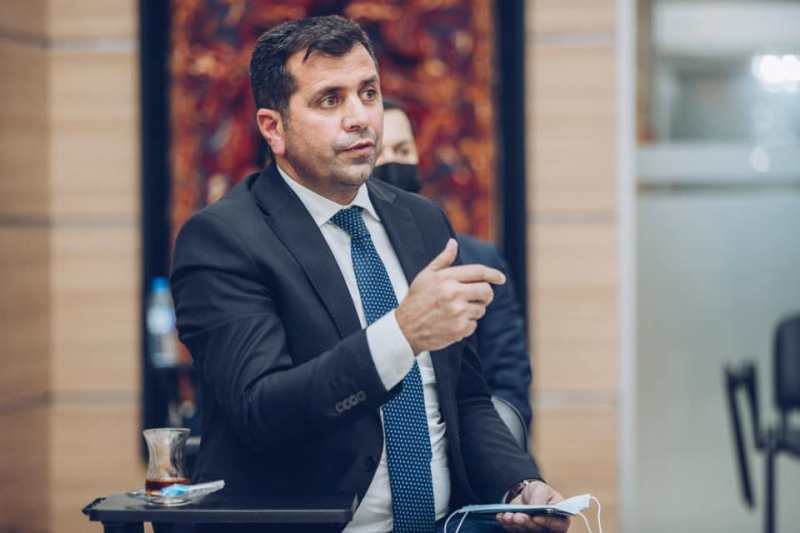
Since 2014, every year on the eve of the Khojaly genocide, I receive calls from various countries around the world. They request the book “Children Who Never Grew Up,” which tells the story of “25 children” whose parents were both murdered during the Khojaly genocide (the youngest of those children is the age of the Khojaly genocide).
I am sure that if someone else had written this book, the calls would have gone to them. What is certain is that these calls do not come to the author, but to “Children Who Never Grew Up.” This also indicates that “Children Who Never Grew Up” has become an eternal attribute of the Khojaly genocide.
I feel that this book is greater than its text; it not only recalls the event but also explains it.
I see that the book “Children Who Never Grew Up” is precisely such a collection, the name of such a responsibility. This book highlights the harshest, most impactful, and most convincing layer of the Khojaly genocide.
This layer consists of children, child testimony. Child testimony is the purest form of fact, devoid of emotional arguments. Because child testimony sometimes conveys the gravest sentence with the simplest words. As they say, it does not “comment,” it “shows.”
Although I am the author of the book, I don't know why, but I often leaf through it, and each time I discover something new. The main point here is that the terrible life stories of the 25 children complement each other. The common root of 25 destinies becomes apparent.
This book reveals how one night spread across hundreds of days, and how one trauma persisted for decades. The most horrifying aspect is that the book clarifies the difference between “getting older” and “growing up.”
This very difference is encoded in the book's title and conveys a message to society's memory. To bring this message to the world, a pen alone was not enough; it required systematic support. This systematic support was provided through the Heydar Aliyev Foundation.

The Khojaly genocide occurred on the night of February 25-26, 1992. For me, this date is also the name of the time that stopped within 25 children. On that night, the parents of 25 children were murdered before their eyes. What happened encompasses not only death but also the wounding of the future. The phrase “future life was shot down” may sound artistic. However, it has accuracy as a social reality. Because a child's future is built upon the existence of the family. When the family collapses, tomorrow also collapses.
I experienced the “cessation of growth” while writing this book. The 25 children depict that moment through a child's language, presenting it as a signal to society. The dissemination of this signal to a global audience was systematized through the Foundation's initiative.
To be honest, this book was actually written by chance. But the necessity within that chance revealed itself.
In 2013, we were interviewing Mehti from Khojaly. Both of Mehti's parents and his brothers had been murdered in Khojaly. What he recounted was horrifying. As Mehti spoke, time stood still, the cold of February returned, and an unseen truth became clear. That truth was that even though he was over 30, he was still a child, he hadn't grown up, he remained a child. Mehti said that he was not alone in this condition. He stated that there were 25 more children like him, 25 children who remained trapped in the same night. After this sentence, the idea for the book became a necessity.
Then we interviewed Khazangul, who shared the same sorrow as Mehti. Her narrative chilled one's blood. Child testimony did not embellish the event; it presented it as it was. I knew that a child's language is the most convincing form of information. For this very reason, the book's concept was built upon “child's language.” In this way, the concept becomes strong both ethically and communicatively. Universal understanding is a fundamental condition for international dissemination. International dissemination is not limited to an idea; it requires resources and coordination. The Heydar Aliyev Foundation's initiative formed the basis of these coordination channels.
I decided that one person's story was not enough; I needed to establish a systematic collection of 25 stories. We listened to each child's story individually and clarified their memories separately.
The idea of gathering and meeting with those children did not leave me in peace, and finally, we held such a meeting in front of the Heydar Aliyev Palace. That meeting had an even more profound impact on me than the Khojaly genocide itself. The meeting revealed the “aftermath” of the genocide. There was years of carried silence, fragmented childhoods. It turned out that they had been separated at ages 2, 3, 4, 5, 6. Many did not know each other. They began to get acquainted. It was horrifying; some said, “You were the one in kindergarten,” “You were that child,” “That was me.” Thus, the acquaintance began. Then hugs, weeping... This weeping was the memory speaking.

Compiling their stories into a book was a difficult process. Listening to them was unbearable; at that moment, I was thinking of them. As they spoke, they went back to the night of February 25-26, 1993, reliving the genocide. This was very painful. But the book had to be written.
As soon as the Heydar Aliyev Foundation learned about the matter, it took on the support. The Foundation's support transformed the project from an individual initiative into an institutional endeavor. The First Vice-President of the Foundation, Mrs. Leyla Aliyeva, approached it with particular sensitivity. Almost all events related to Khojaly invited these children. The Foundation's initiative became the platform that brought this testimony to an international audience. This support broadened the book's mission.
Soon after, these children were provided with homes for compact living in Romania. This initiative was an indicator of a humanitarian approach, taking into account the daily life dimension of trauma. The Foundation's initiative did not limit the project to text alone. It also addressed the social well-being of the witnesses.
Through the Foundation's initiative, the book was published in 7 languages. This became the project's information strategy, a plan for reaching new audiences. Naturally, each language means a new reader. As the readership grew, discussions also increased, and the visibility of the Khojaly truth accelerated.
Today, the book is in libraries in various countries around the world; this is no coincidence. This is the result of systematic dissemination and coordination established through the Foundation's initiative. The online circulation of the book in 7 languages is also a significant stage. Online dissemination eliminates borders. When borders are eliminated, the truth spreads faster. Behind this speed also lay the plan established through the Foundation's initiative. The Foundation's initiative transformed this book into a document that saw the light of day.

Khojaly is our unforgettable historical page. Khojaly is not just the past; it is also the responsibility of today. The book “Children Who Never Grew Up” is the written document of this responsibility. This book is the speaking voice, the living witness of the Khojaly genocide. This book is undeniable proof of the genocide. The dissemination of this proof on a global scale was made possible through the Heydar Aliyev Foundation's initiative.
For the children who never grew up to grow, they needed not just years, but for justice to be heard. Leyla Aliyeva's initiated “Justice for Khojaly” began to help those children grow. Khojaly, which had been razed to the ground, began to revive. Because the world began to hear this justice through "Justice for Khojaly."
In 2020, under the leadership of the Commander-in-Chief, Karabakh was liberated from occupation. This victory was also the revival of memory. The path to Khojaly became visible. This path was the movement of time that had stopped within the 25 children.
In 2023, the heroic sons of Azerbaijan, under the Great Commandership of the Commander-in-Chief, also liberated Khojaly. The liberation of Khojaly was a historic step taken towards the completion of unfinished destinies. This was the awakening of a memory that had been silent for years.
Khojaly revived. It was not only the city that revived. Hope and faith revived. The time that had frozen within the “children who never grew up” revived.
The children who never grew up, grew up.
Today marks the 33rd anniversary of the Khojaly genocide. Azerbaijan will never forget this genocide. Because the day of the genocide is the responsibility of the future, a bridge built between memory and justice.

Today we can say that Khojaly is a symbol of return.
The children who never grew up, grew up.
Leyla Aliyeva's initiated call for “Justice for Khojaly” resonated on international platforms for years. This call was a systematic memory policy. This call was the initiative that brought child testimony to world tribunals. This call was the path that served to make the truth transcend borders.
If Khojaly has revived, it means we have restored justice. If the children who never grew up have grown up, it means time has returned to its place. This return is the result of memory, struggle, and faith in justice.




