
What terrified Banin, the émigré granddaughter of an Azerbaijani millionaire, at midnight and forced her to spend the night at a neighbor's?
“...The lights went out, and the house and city were plunged into deep darkness. Whizzing bullets, whose origin was unknown, pierced this darkness. Machine gun fire could also be heard from afar. Every minute we expected the 'Dashnaks' (this was the name of the nationalist Armenian party) to storm the house, destroy our apartment, and slaughter us. The telephone was also cut off; the area around our house resembled an island full of danger.”
These anxious lines are from "Caucasian Days," a novel published in Paris in 1946 by Ummulbanu (literary pseudonym Banin), the granddaughter of famous Azerbaijani millionaires Shamsi Asadullayev and Musa Naghiyev, and the daughter of millionaire Mirza Asadullayev, one of the ministers of the Azerbaijan Democratic Republic. In her autobiographical novel, Banin recalls with deep sorrow witnessing Armenian looting from the window of the house where they were hiding in the neighborhood as dawn broke, and how their own house was plundered by Armenians, with all their belongings – forks and spoons, carpets and rugs, candlesticks, clothes, and even her beloved toys – being loaded onto a truck. The Azerbaijani-born French writer Banin also describes the Armenian atrocities committed in Baku in 1918 in her novel "Nami" (1942). Nami writes in her diary that the Armenians' goal was to create chaos and use it to slaughter Azerbaijanis. Nami's diary entries confirm this: “It was not yet clear whether the armed groups were Armenians or Bolsheviks; perhaps both could break into the house at any time.” These words not only reflect the real picture of that period but also reveal many facts, indicating the involvement of Russians in organizing the events.
It should be noted that the artistic and journalistic reflection of the March 31 tragedy has always been a topic of constant attention for émigrés. In the "Azerbaijan" journal published by the Azerbaijan Culture Association in Ankara in 1952, regular articles and research materials were published regarding the essence of the events, their causes, and their terrible consequences. One of the most active authors writing on this topic was Mirza Bala Mammadzade. Mirza Bala Mammadzade's extensive article titled "On the Occasion of the 40th Anniversary of the Declaration of Independence of the Caucasian Countries," published in issues 2-3 of the journal in May-June 1958, holds great historical significance in terms of its realistic reflection of historical events. M. B. Mammadzade, providing a realistic description of Armenian atrocities in the article, writes that after this massacre, sabotage, and looting, which resulted in the martyrdom of tens of thousands of Turks, the 11-member Baku Soviet government formed on April 25 included 5 Armenians, 3 Russians, 1 Georgian, and only 2 Azerbaijanis, one of whom was a Bolshevik. At the end of the article, which the author wrote based on historical sources, it is noted that: “After the collapse of the Caucasian Confederation, Azerbaijanis signed an agreement with Turkey on June 4, 1918, and thanks to the military assistance they received in accordance with Article 4 of this agreement, they repelled the enemy advancing to the gates of Ganja and succeeded in concluding the bloody war, which lasted from April to September 15, with victory. This victory of the Azerbaijanis saved the entire Caucasus from being subjected to Soviet barbarism.”
The "Azerbaijan" journal, published in Ankara, consistently dedicated extensive space to the March 31 tragedy on its pages, publishing materials and photographs related to the genocide. The main purpose and objective of the articles published and photos shared in the journal was to transmit the tragedy to future generations, to draw lessons from its consequences, and to inform future generations.
In the 31st issue of the "Istiqlal" newspaper, published in Berlin on April 1, 1933, two extensive articles related to the topic of genocide were published: "The Fifteenth Anniversary of a Massacre" and "March 31." The author of the article "The Fifteenth Anniversary of a Massacre," Mirza Bala Mammadzade, depicts with realistic colors the tragedies perpetrated by Armenians in Baku and other regions of Azerbaijan in 1918 with the incitement and assistance of the Bolsheviks: “With this massacre, the blood of 15,000 innocent Azerbaijanis was shed within 3 days, properties and homes were razed to the ground, and everything was drenched in blood. For a full 3 days and 3 nights, bombs and grenades rained down on Baku from land, sky, and sea. This massacre was not limited to Baku; Shaumyan, Avakyan, Arakelyan, Amazars, and Lalayan's 'red heroes,' as they put it, after 'breaking through Turkey's Baku front,' moved north to Guba, west to Shirvan, and south to Mugan and Lankaran, slaughtering tens of thousands of Azerbaijanis. The Eastern Azerbaijan Republic was entirely engulfed in flames. In Shamakhi, Amirov, and in Salyan, Mugan, Lankaran, and Astara, Lalayev and their gangs “went from house to house committing unspeakable atrocities, slaughtering the population, and torturing women and girls.”
In the same issue of "Istiqlal," another article titled "March 31," presented under the pseudonym "V. Nuh oglu," holds great significance in revealing the essence of the March genocide perpetrated by Armenians and in understanding the events of that period: “On March 22, 1918, the magnificent hall of Baku's 'Ismailiyya' building vibrated with the sounds of national music, dance, laughter, and joy... The nation was celebrating Novruz. A week later, on March 31, that historic building, this old palace where all of Azerbaijan's political, scientific, literary, artistic, economic, and public societies and organizations, libraries, reading rooms, and orphanages were located, was in mourning, a desolate shell. It had been burned. It was not only 'Ismailiyya' that was burned: all printing houses, press offices, national theater buildings, schools, hospitals, mosques, and national-cultural institutions belonging to Turks were razed to the ground.”
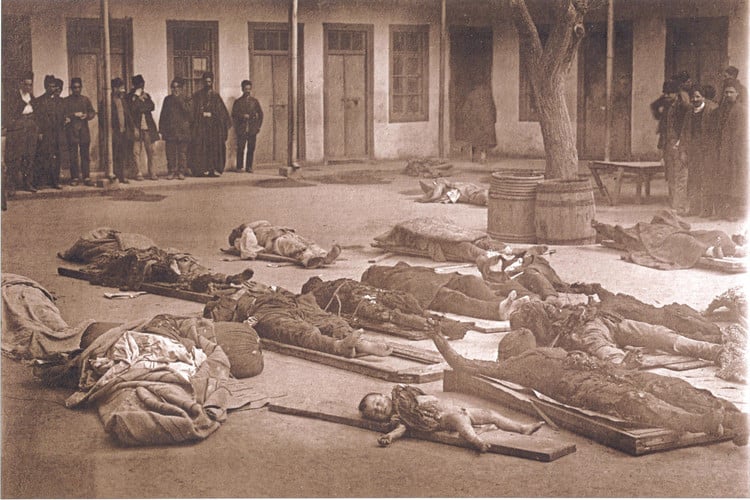
To enhance the impact of the writing, the author refers to the memoirs of foreigners who worked in Baku during that period and witnessed this tragedy. It is impossible to read calmly what a foreigner named M. Kulka wrote: “Armenian soldiers entered Muslim neighborhoods, killed the inhabitants, dismembered them with swords, pierced them with bayonets, threw children into fires to burn them alive, and impaled three- or four-day-old infants on their bayonets.”
The foreigner M. Kulka, who witnessed the Armenian barbarity with his own eyes, notes that the Armenians tied the hair of Muslim women they did not kill together, dragged them naked through the streets, struck their bodies with rifle butts, cruelly killed children, and committed horrific acts of violence without sparing anyone: “A beloved Azerbaijani infant, as lovely as an angel, was nailed to the wall in Baku. The nail was driven directly through the infant's heart; a pile of dead children, boys and girls, with large shepherd dogs on top of them, one of which was gnawing at an innocent infant; a naked woman lay dead on the ground, a cub suckling at the dried breasts of this lifeless p.”
Mirza Bala Mammadzade's extensive article titled "On the Occasion of the 40th Anniversary of the Declaration of Independence of the Caucasian Countries," published in issues 2-3 of the journal in May-June 1958, by one of the prominent writers of the émigré press, can be regarded as a valuable research work on this topic and holds great historical significance in terms of its realistic reflection of historical events.
One of the key figures who illuminated the topic of the March 31 genocide in the émigré press was M.A. Rasulzade. In his article titled "From the Great Days of Turkism (On the Occasion of September 15)," it is stated: “March 31, 1918, became a new Ashura for the Muslims of Baku, and their homeland a Karbala. The Dashnaktsutyun party, entering into an alliance with the Bolsheviks, subjected the Turkish neighborhoods of the city to a massacre for three days and three nights, executing over ten thousand unarmed inhabitants by gunfire. After the center of the Azerbaijani national movement was punished, the massacre continued in Shamakhi, Guba, Lankaran, Salyan, and other regions.”
M.A. Rasulzade's article, published in 1924 under the pseudonym "Azeri" and titled "March 31, 1918," is significant for obtaining more extensive and detailed information about the massacres perpetrated with particular cruelty by Dashnak-Bolshevik armed groups operating under the mandate of the Baku Soviet in March-April 1918, and for understanding the essence, causes, and scale of the crime written in bloody letters into the history and destiny of our people. In the article, the author evaluates March 31 as “one of the saddest and bloodiest dates” to be inscribed in the history of the formation of the Azerbaijan Republic: “During those days, the Muslim neighborhoods of the city were 'put to the torch' by Armenians, the Muslim market was plundered, the minarets of the Tezepir Mosque were riddled with shells, and the naked bodies of women with severed breasts and the lifeless bodies of infants were thrown into the streets.”
In the great publicist's article of the same name, published in 1925, detailed information was provided about Soviet Russia's dirty policy in the Caucasus on the eve of the March tragedy, S. Shaumyan's implementation of insidious plans related to Baku in accordance with V.I. Lenin's instructions, including the deployment and maintenance of numerous armed Russian and Armenian soldiers returning from the front in the city, and the geography, cruelty, and consequences of the March massacre.
One of M.A. Rasulzade's articles on the March 31 genocide is "The Armenian Question," published under the pseudonym "Azeri" in the "Yeni Qafqasya" journal on May 15, 1924. The article draws attention with the author's interesting reflections, deep and objective analysis, and evaluation of the approach to the problem, the emergence of this dirty policy, its historical roots, and the process leading to the March massacres. M.A. Rasulzade notes that the history and essence of the "Armenian question," which dominated the press, are not known to everyone, and that just as it harmed the Turkic world, it also became a cause of disaster for Armenians: “It means that history repeats itself. Armenian émigrés settled by Tsarism are now protected by Bolshevism. Tsarism did not only create Armenian settlements in the Don region; it also strengthened Armenian presence in Transcaucasia. It had settled Armenians migrating from Turkey here. The nation Tsarism relied on in the Caucasus was the Armenians. The leaders of Russian capitalism and Russian colonization were the Armenian elite and Armenian speculators.”
Is there a need to commemorate March 31 Genocide Day every year? There is only one answer to this question: History does not like forgetfulness and punishes severely!
Esmira Ismayilova,
Doctor of Philosophy in Philology, Associate Professor





