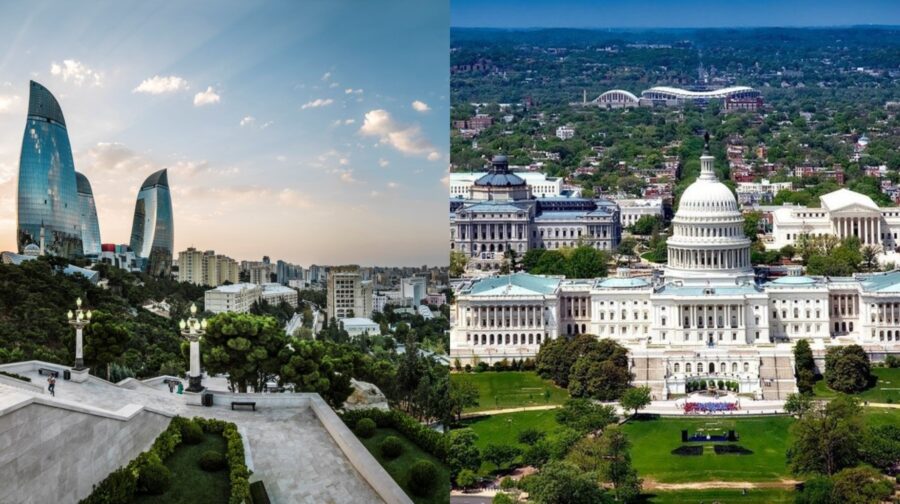
The expected visit of US Vice President James David (JD) Vance to the South Caucasus is regarded as a significant "geopolitical return" in Washington's foreign policy. The relative coolness and biased approaches observed during the Biden administration are giving way to a new model, more pragmatic, economically focused, and based on strategic alliances, with the return of Donald Trump to power.
JD Vance's planned visit to the region on February 9-10 is not merely a diplomatic move, but signifies a redefinition of US interests in the region. Washington no longer views the South Caucasus through an ideological lens, but through the principle of "Peace through Construction" (İnşaat vasitəsilə sülh), meaning via economic and transport projects.
Relations between Azerbaijani President Ilham Aliyev and the Donald Trump administration have entered a "warm" phase based on mutual respect and concrete results. These relations have several pillars:
Personal rapport between leaders: President Ilham Aliyev's resolute and independent policy fully aligns with the Trump administration's concept of "strong leaders and clear interests." The meeting held in Davos in January further strengthened this personal trust.
On the other hand, the de facto freezing of the application of Section 907, which was discriminatory for Azerbaijan, with Trump's arrival in power, is regarded by Baku as "the end of 33 years of injustice."
The initiation of discussions regarding Azerbaijan's acquisition of modern defense technology from the US indicates that the strategic partnership between the two countries has risen to a new level.

The main thrust of relations is based on the historic achievement made in Washington on August 8, 2025. During the trilateral meeting between Ilham Aliyev and Nikol Pashinyan, mediated by Donald Trump, the text of a peace agreement was initialed and a peace declaration was signed. At the heart of the agreement lies the "Trump Route for International Peace and Prosperity" (TRIPP). This is a transport and energy corridor connecting the main part of Azerbaijan with Nakhchivan (in the context of the Zangezur corridor). The main purpose of the visit is precisely to accelerate the implementation of this route and to strengthen a new "East-West" artery in the region, independent of Russia.
This project is a symbol of the US's new vision for the region. Washington no longer wishes to act merely as a "mediator" in the region, but also as a manager and guarantor of strategic infrastructure. Analysts note that personal relations (personal diplomacy) play a decisive role in Trump's foreign policy. Trump regards Ilham Aliyev as a strong leader of the region who is true to his word. The meeting held in Davos in January 2026 once again confirmed how strong this "chemistry" is. In this meeting, Trump called Azerbaijan a "strategic partner" and emphasized that our country is a guarantor of peace in the region. Both leaders prefer "deals" built on economic benefit and real security, far from ideological frameworks.
Interestingly, Georgia was not included in Vance's itinerary. This indicates a shift in Washington's priorities in the South Caucasus. The US now sees the "key" to the region in Baku. Azerbaijan's energy resources (including gas exports to Armenia) and logistical capabilities make it an indispensable partner for Washington.
The US's return to the South Caucasus not only balances the influence of Russia and Iran in the region but also signifies its recognition of the new status quo following Azerbaijan's full restoration of its territorial integrity. President Ilham Aliyev's balanced policy and the direct contacts established with the Trump administration have made Azerbaijan the winner and central actor in this new geopolitical game.