Sometimes, the essence of great wars is better revealed not by generals' maps, front lines, or missile counts, but by a single sentence uttered in a closed room.
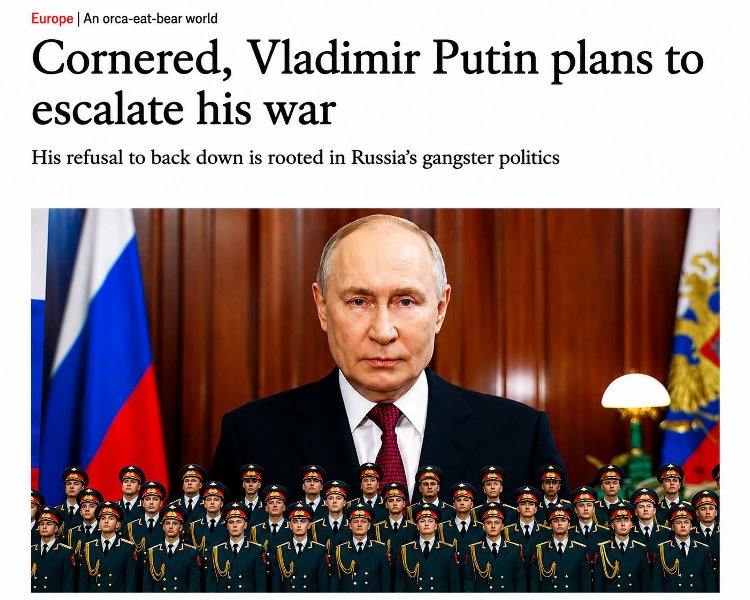
According to a claim by the influential British magazine "The Economist," citing a source close to Vladimir Putin, the Russian president said this to his inner circle at some stage of the war:
"They will hang me."
We do not know if these words were actually spoken. The magazine does not disclose the source's name. It is also unknown when and under what circumstances the conversation took place. We also do not know who "they" are – the West, Ukraine, the Russian elite, or war supporters who will not forgive defeat.
Therefore, this sentence cannot be taken as a confirmed quote from Putin.
But even as a sentence spoken by an anonymous source, it reveals the dangerous logic of war. Because starting a war is not the same as ending a war.
When a government starts a war, it sets political and military goals. Territory, security, prestige, spheres of influence, historical claims... But years pass, tens of thousands of people die, billions of dollars are spent, and the economy and society are adapted to the demands of war.
Then a strange phase begins.
The question is no longer "What will we gain?" The question changes:
"If we stop now, how will we explain all this?"
Another idea expressed by one of "The Economist's" sources in the Russian elite is therefore more interesting. According to him, there is a growing feeling within the elite:
"The emperor has no clothes."
This phrase is perhaps more significant than the sentence "They will hang me."
The greatest asset of authoritarian rule is not just the army, police, and money. One of its main assets is the perception of invincibility.
As long as everyone believes the ruler is strong, his power truly grows. The elite obeys him, officials carry out orders, rivals remain silent. But one day, when the question "perhaps he is not as strong as he used to be?" enters the minds of those same people, one of the invisible pillars of power begins to crack.
There are terrifying examples of this in history.
In 1917, the rule of Nicholas II did not collapse solely due to the defeats of the Russian army. As the war dragged on for years, the idea that the state was ungovernable spread to the court, generals, aristocracy, and even the very foundations of the monarchy. When the Tsar was dethroned, it was not the Bolsheviks who overthrew him first. A large part of his own generals no longer considered his continued rule a solution.
This is one of the most dangerous characteristics of war for rulers.
After a while, defeat can cease to be a military consequence for the state and become a personal danger for the leader.
And from that moment on, the interest of the state and the interest of the ruler begin to diverge.
For the state, compromise may be beneficial;
For society, stopping the war may be beneficial;
For the soldier, returning home may be beneficial.
But if compromise means losing power for the leader, his calculation is completely different.
At this point, peace can strangely seem more dangerous than war.
In psychology, there is a similar concept: the sunk cost fallacy. After investing a lot of money, time, and effort into something, people find it difficult to accept that it is meaningless. Logically, they should stop, but they agree to more losses to justify previous ones.
In war, this mechanism takes on a terrifying scale.
If you have fought for five years, you must give meaning to the sacrifices of those five years.
For this, you sacrifice the sixth year.
After the sixth year, it becomes easier to justify the seventh.
Thus, a war initially fought to achieve a goal one day turns into a war fought to avoid making past sacrifices seem meaningless.
If the sentence "They will hang me" spoken by "The Economist's" source is true, its real weight lies here.
This is not a sentence about a frightened person.
This is about a more dangerous situation:
"It is about the fact that a country's exit door from war and a ruler's personal exit door are no longer in the same place."
History shows that in such moments, the most dangerous question is not whether the ruler will win the war. The most dangerous question is:
If he does not see his future after peace, why would he choose peace?