In the modern world, the international weight of states is not determined only by the size of their territory, population, and economy. The country's geographical position, its ability to influence regional processes, and its location on transport and communication lines connecting various economic spaces are also among the main factors determining its strategic importance. Especially at the current stage, when global economic activity is increasingly directed towards Asia, and new transport and energy routes gain geopolitical significance along with economic interests, the role of countries connecting large geographies increases even more.
Azerbaijan is one of such states with a strategic position. Our country's location at the intersection of Europe and Asia, its access to the Caspian Sea, and the modern transport infrastructure it has formed allow it to play an important connecting role between Central Asia, the South Caucasus, Turkey, and Europe. The strengthening of Azerbaijan's position in the system of international relations in recent years is also accompanied by a more effective realization of these opportunities.
In this process, the independent, consistent, and national interest-based foreign policy pursued by President Ilham Aliyev plays an important role. This policy has enabled Azerbaijan to establish mutually beneficial cooperation with various power centers and to actively participate in regional and global processes. The full restoration of Azerbaijan's territorial integrity and sovereignty is one of the important results of the policy implemented to ensure the national interests of our state.
In recent years, Azerbaijan's political, economic, transport, energy, and humanitarian ties with leading Asian countries have significantly expanded. This process has not only strengthened our country's position as a reliable partner in the Eurasian space but also increased the importance of cooperation with various multilateral platforms. In this regard, the Shanghai Cooperation Organization (SCO) is one of the important international platforms that Azerbaijan pays attention to.
AZERTAC analyzes the factors determining the increasing importance of Azerbaijan-SCO cooperation, existing relations, and new cooperation opportunities.
The SCO, which will celebrate its 25th anniversary in 2026, today unites 10 full members. The geography covered by the organization is approximately 36 million square kilometers, and the total population of member countries is more than 3.4 billion people. According to World Bank data for 2025, the total nominal GDP of the 10 SCO member countries is approximately 27.4 trillion dollars, which is equivalent to approximately 23.1 percent of the world's GDP.
Among the members of the organization are global economic and political powers such as China, India, and Russia, as well as geostrategically important states such as Iran and Pakistan, and Central Asian countries such as Kazakhstan, Uzbekistan, Kyrgyzstan, and Tajikistan. With the membership of Belarus, the SCO's coverage in Eurasia has further expanded. In addition to the 10 full members of the organization, there are 2 observer countries and 15 dialogue partners.
The SCO unites on one platform the world's largest population and consumer markets on the one hand, and countries with rich energy and raw material resources, as well as the main land transport routes of Eurasia, on the other. This feature further increases the economic and geopolitical importance of the organization.
Azerbaijan is connected to this vast space not only through bilateral relations but also within the framework of institutional cooperation. Our country has been a dialogue partner of the SCO since 2015. This status has allowed Azerbaijan to expand its relations with the organization's political, economic, transport, energy, security, and humanitarian agenda.
SCO's 25-year development path and expanding agenda
The current scale of the SCO can be understood by looking at its past. The organization was initially based on mechanisms aimed at strengthening trust at the borders between China and the post-Soviet states of Central Asia, reducing military risks, and ensuring mutual security. Later, this cooperation evolved into an international organization with a broader political, security, economic, and humanitarian agenda.
Established in Shanghai on June 15, 2001, the SCO initially united China, Russia, Kazakhstan, Kyrgyzstan, Tajikistan, and Uzbekistan. In subsequent years, the organization's geography expanded: India and Pakistan joined as full members in 2017, Iran in 2023, and Belarus in 2024.
The legal basis of the organization is the SCO Charter signed in 2002. The document enshrines principles such as mutual respect for the sovereignty, independence, territorial integrity, and inviolability of borders of states, non-interference in internal affairs, non-use of force, and peaceful resolution of disputes. The Charter also defines the equality of member states and that the SCO is not directed against other states and international organizations. This approach reveals an important feature of the organization. The SCO is not a single political or military bloc. It includes states with different political systems, foreign policy priorities, and economic interests. Nevertheless, these states cooperate on issues of common interest on the same platform.
The fact that the organization's legal framework covers more than 25 agreements and other normative documents, and its activities are not limited to security, indicates that the SCO has become a broad institutional cooperation system. In addition to combating terrorism, separatism, extremism, illegal trafficking of drugs and weapons, and transnational crime, the development of economic and investment cooperation, transport and communication infrastructure, transit opportunities, and energy systems are also on the organization's agenda.
The SCO Development Strategy until 2035 also defines the future directions of the organization. The document prioritizes, in addition to security, the expansion of trade, economic, and investment cooperation, the implementation of joint projects, and the development of relations in the fields of science and technology, health, environment, and education. In this regard, it would not be correct to present the SCO only as a security organization. Its activities cover a wide range of areas, from political-diplomatic dialogue to economy, from energy to transport, from science to education.
Huge markets and economic potential
The main strength of the SCO is determined by its demographic and economic scale. The organization's space includes the world's largest population and consumption centers such as China and India. Russia, Pakistan, and Iran also have large populations and extensive domestic markets. This means not only consumption potential but also large labor resources, industrial capabilities, and a broad base for future economic growth. China's nominal GDP of approximately 19.5 trillion dollars, India's 3.96 trillion dollars, and Russia's 2.56 trillion dollars clearly demonstrate the economic scale of the SCO space. The rapid development of Central Asian economies such as Kazakhstan and Uzbekistan also completes this picture.
For Azerbaijan, this space is important both in terms of existing trade relations and in terms of expanding transport, logistics, investment, industrial, and energy opportunities. However, our country's main advantage is not in competing with SCO members in terms of economic scale, but in being able to connect this huge economic space with broader Eurasian markets.
Energy and transport: Strategic arteries of the SCO space
The SCO geography includes both major energy producers and major energy consumers of the world. Russia, Iran, and Kazakhstan have significant oil and gas reserves. China and India are among the main centers of global energy demand.
In the modern world, the existence of energy resources, as well as their delivery to consumption markets through safe, stable, and diversified routes, is of strategic importance. Azerbaijan's advantage is precisely at this stage. Our country is not the largest energy producer in the SCO. However, Azerbaijan is one of the important states that create a connection between energy producing regions and consumption markets. The Southern Gas Corridor is the clearest example of this. This energy system, approximately 3500 kilometers long, delivers Azerbaijani gas to Europe via Georgia and Turkey. In 2025, Azerbaijan supplied 12.5 billion cubic meters of natural gas to EU member states through this corridor. Projects such as Baku-Tbilisi-Ceyhan, TANAP, and TAP also demonstrate Azerbaijan's ability to connect various regions through its energy infrastructure. The Zangazur corridor (TRIPP), currently under development, can further expand these connection opportunities.
The same logic applies to the transport sector. The SCO space covers a large part of the main land transport directions extending from East to West, and from North to South. The expansion of relations between the production and trade centers of China and Central Asia, the directions of Russia, Iran, and India, the Caspian basin, and Western markets brings new logistics opportunities to the forefront. Azerbaijan has a special geographical position on this map. Our country is located at the intersection of East-West and North-South transport routes simultaneously. Baku Port, Baku-Tbilisi-Kars railway, Middle Corridor, and "North-South" International Transport Corridor create connections in various directions. The annual cargo handling capacity of Baku International Sea Trade Port for the first phase is 15 million tons and 100 thousand TEU, and the planned increase of this capacity to 25 million tons and 500 thousand TEU in the future can further strengthen Azerbaijan's role in this transport system.
Azerbaijan's strategic place in the vast SCO space
This is where the main logic of Azerbaijan-SCO relations emerges. It would not be correct to measure Azerbaijan's advantage over the SCO only by the country's economic indicators. The main advantage is the geography where Azerbaijan is located. China, India, and Pakistan are in the east of the SCO, Russia in the north, Iran in the south, and Central Asia in the center. Azerbaijan is located on the western shore of the Caspian, on the routes connecting a significant part of this vast space with Turkey and Europe. On one side are the huge production and consumption markets of China and Central Asia, and on the other side is Europe. Russia, Iran, and India are located in other directions. At the intersection of these geo-economic lines, Azerbaijan can play an important connecting role between the SCO space and the West.
Our country's experience in multilateral diplomacy also complements this position. Azerbaijan's chairmanship of the Non-Aligned Movement in 2019-2023, hosting COP29 and the World Urban Forum, membership in D-8, and the holding of the Economic Cooperation Organization Summit in Khankendi in 2026 demonstrate Azerbaijan's active role in various regional and international platforms. Azerbaijan's chairmanship of the Conference on Interaction and Confidence Building Measures in Asia in 2024-2026 and the planned holding of the CICA Summit in Baku this year also expand our country's multilateral diplomacy capabilities.
In this regard, it is not enough to approach the issue only with the question "What does Azerbaijan gain from cooperation with the SCO?". Another important question is: What new opportunities does the SCO space gain through Azerbaijan?
The answer, first of all, is connection. The Caspian Sea, Baku Port, Middle Corridor, Baku-Tbilisi-Kars railway, "North-South" route, Southern Gas Corridor, and future regional transport connections strengthen Azerbaijan's strategic role between East and West, North and South.
In particular, the development of the Trans-Caspian International Transport Route and the Middle Corridor strengthens Azerbaijan's position as an important partner in ensuring access to Europe from Central Asia and China. The expansion of bilateral relations with Central Asian countries, China, and other SCO members further strengthens the political and economic foundations of this multilateral cooperation.
New political dynamics in Azerbaijan-SCO relations
In recent years, the political dynamics in Azerbaijan-SCO relations have significantly increased. The China factor plays a special role in this process. In the "Joint Declaration on the Establishment of Strategic Partnership" signed between Azerbaijan and China in Astana on July 3, 2024, China welcomed Azerbaijan's efforts to strengthen cooperation within the SCO and expressed its support for raising our country's legal status in the organization.
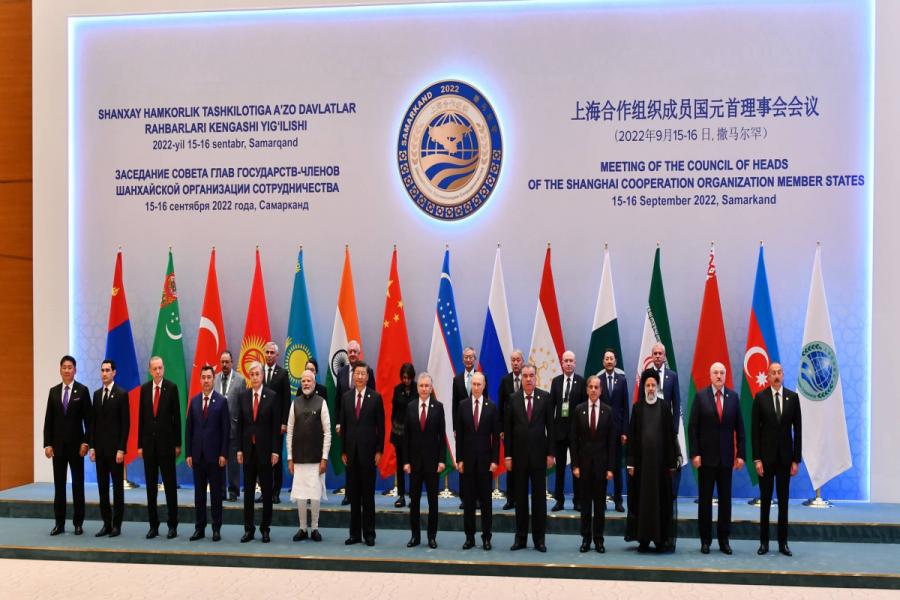
China's position as one of the leading states of the SCO and the development of its strategic partnership with Azerbaijan create new opportunities in this direction. The intensification of Azerbaijan's political contacts with the SCO is also demonstrated by President Ilham Aliyev's participation in high-level events of the organization. The head of our state participated as an honorary guest at the SCO Summit held in Uzbekistan in 2022, delivered a speech at the summit held in Kazakhstan in 2024, and participated in the organization's events in Tianjin, China, in 2025.
The elevation of Azerbaijan-China relations to a new level in recent years is also one of the factors strengthening the practical content of cooperation within the SCO. Azerbaijan's support for the "One Belt, One Road" initiative, the operation of the "Azerbaijan Trade House" in China, and the expansion of relations in trade, investment, and logistics strengthen the economic foundations of cooperation between the two countries. President Ilham Aliyev's participation in the "SCO plus" format meeting held in Tianjin on August 31, 2025, was also of particular importance in this regard. The head of our state stated that Azerbaijan-China relations have reached a qualitatively new stage in the last two years, and the transition from strategic partnership to comprehensive strategic partnership has been formalized. At the same time, he emphasized that Azerbaijan supports China's Global Development, Global Security, and Global Civilization initiatives. The discussion of the issue of expanding Azerbaijan's relations with the SCO during the meeting with Xi Jinping on the same day also showed the importance of this direction in the bilateral agenda.
Azerbaijan's cooperation with the SCO covers not only political dialogue but also security, economic, and humanitarian fields. Combating terrorism, extremism, separatism, illegal drug trafficking, cybercrime, and transnational organized crime occupies an important place on the security agenda. In the economic field, in addition to trade and investments, the development of energy, agriculture, transport and communications, telecommunications, small and medium-sized businesses, multimodal corridors, and transit opportunities comes to the forefront.
Humanitarian cooperation is also one of the important directions of relations. Relations in the fields of culture, education, science, health, tourism, inter-civilizational dialogue, multiculturalism, and tolerance show that the partnership is not based solely on political and economic interests.
The decision adopted at the Tianjin Summit in 2025 was also an important stage in the institutional development of Azerbaijan's partnership with the organization. The unification of observer and dialogue partner statuses into a single "SCO partner" status created conditions for updating cooperation mechanisms within the organization, and Azerbaijan also joined the new partnership format.
The celebration of the 25th anniversary of the SCO's establishment in 2026 has increased attention to a new stage in the organization's development. The determination of the slogan "25 years of SCO: Together for sustainable peace, development, and prosperity" during Kyrgyzstan's chairmanship, and the holding of jubilee events and the Summit in Bishkek, indicate the relevance of the organization's future agenda.
One of the striking examples of the humanitarian and cultural dimension of Azerbaijan-SCO cooperation is the promotion of Nizami Ganjavi's heritage in the organization's space. In 2021, on the initiative of the Heydar Aliyev Foundation, his bust was erected at the SCO headquarters in Beijing on the occasion of the poet's 880th anniversary. Thus, Nizami Ganjavi's heritage was presented as one of the important symbols of Azerbaijani culture in the SCO space.
Azerbaijan-SCO economic cooperation
One of the main factors strengthening Azerbaijan's position in the SCO space is the rapid development of relations with Central Asian states. In this regard, the SCO Summit to be held in Bishkek, the capital of Kyrgyzstan, in 2026, is of particular importance.
The elevation of Azerbaijan-Kyrgyzstan relations to a new stage with the Agreement on Allied Relations signed on July 31 of this year, the activities of the Intergovernmental Council, high-level mutual visits, and humanitarian projects show that cooperation between the two countries has strong institutional foundations. The high level of these relations against the background of Kyrgyzstan's chairmanship of the SCO creates additional political and economic opportunities for Azerbaijan's relations with the organization.
Azerbaijan's policy of parallel cooperation with various geopolitical spaces also expands the content of its relations with the SCO. The development of political and economic ties with Europe, and the deepening of cooperation with the Turkic world and Islamic countries, strengthen our country's coordinating role among various regional platforms. The formation of new peace realities in the South Caucasus adds additional content to these opportunities in terms of transport and economic connections.
The initialing of a peace agreement between Azerbaijan and Armenia in Washington opens new perspectives for long-term stability and cooperation in the region. The strengthening of the peace agenda can create favorable conditions for the expansion of East-West and North-South transport connections, the development of regional logistics, and the implementation of new economic projects. The development of the Zangazur corridor is also one of the factors increasing Azerbaijan's connection opportunities with Central Asia and the broader SCO space.
Political dialogue is complemented by economic cooperation. In 2025, Azerbaijan's total foreign trade turnover amounted to 48.9 billion dollars. In the same year, Russia accounted for 10 percent, China 9.9 percent, Uzbekistan 1.6 percent, Kazakhstan 1.4 percent, and Iran 1.3 percent of foreign trade. These indicators show that SCO members have already become real and significant economic partners for Azerbaijan.
The potential for expanding relations is not limited to trade. The SCO space creates great opportunities for Azerbaijan in terms of expanding cooperation in transport and logistics, investment, industry, energy, and the non-oil sector. Azerbaijan's position in the Middle Corridor, transport connections over the Caspian, and access to European markets, combined with the growing production and export potential of SCO countries, can create conditions for the formation of new economic chains.
The strengthening of peace in the South Caucasus creates additional opportunities for a more efficient integration of East-West and North-South routes. In this regard, the development of Azerbaijan-Kyrgyzstan relations, increasing economic cooperation with Central Asian countries, and deepening strategic partnership with China act as separate elements of a broader regional connection.
The future of Azerbaijan-SCO cooperation should not be approached only from the perspective of the formal expansion of relations with the organization. The main issue is how Azerbaijan can combine the vast economic and geopolitical opportunities created by the SCO space with its transport, energy, investment, and diplomatic potential.
The strength of the SCO lies in its vast geography, population, economic resources, and markets, while Azerbaijan's advantage lies in its geographical position connecting this vast space with the Western direction over the Caspian. Azerbaijan's main advantage is not in competing with SCO countries in terms of scale, but in transforming the economic potential created by that space into transport, logistics, energy, and investment opportunities.
In the changing geopolitical and geo-economic map of modern Eurasia, the intersection of these two factors - the scale of the SCO and Azerbaijan's connectivity capabilities - forms the main strategic content of Azerbaijan-SCO cooperation.