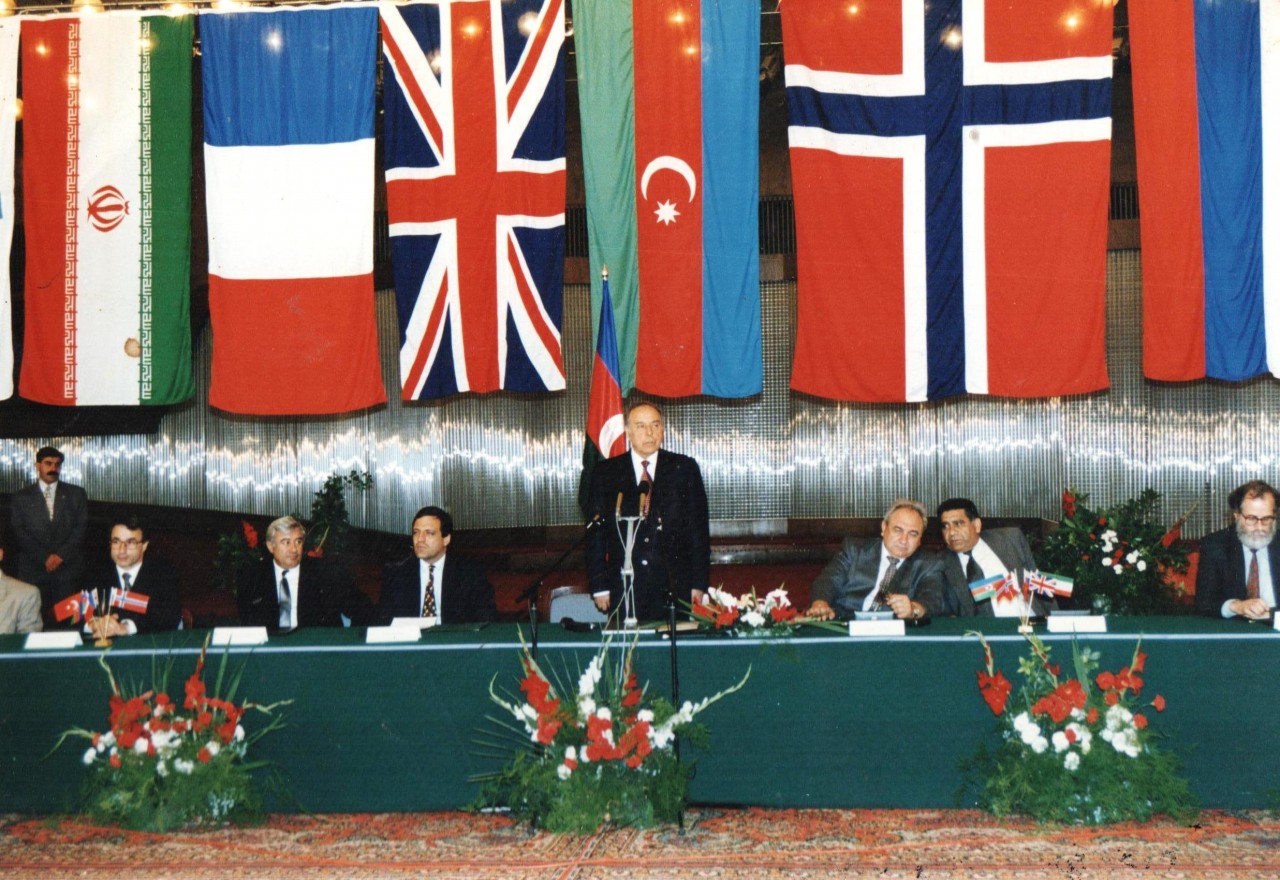
The “Contract of the Century”, signed on September 20, 1994, at the “Gulustan” Palace in Baku, became a turning point in Azerbaijan’s entire economic life.
When the agreement on the development of the “Azeri”, “Chirag” and “Gunashli” fields in the Azerbaijani sector of the Caspian Sea was signed, the country had just emerged from war, facing economic decline and hyperinflation. For foreign investors, Azerbaijan was considered a country with great potential, but also high risks.
Modern.az investigated the main economic indicators of the “Contract of the Century”.
According to the World Bank, the Azerbaijani economy shrank by 19.7 percent in 1994. The decline continued in 1995, with GDP decreasing by another 11.8 percent.
However, from 1996 onwards, the situation began to change. In that year, the economy recorded a 1.3 percent growth. The growth rate reached 5.8 percent in 1997, 10 percent in 1998, and 7.4 percent in 1999.
Thus, the Azerbaijani economy, which had shrunk by approximately 20 percent in the year the “Contract of the Century” was signed, showed a 7.4 percent growth five years later. In the overall result of 1994–1999, the real economy had grown by approximately 11.7 percent.
In 1994, Azerbaijan's nominal gross domestic product was only 1.19 billion dollars. In 1999, this indicator rose to 4.58 billion dollars.
In other words, the volume of the country's economy in dollar terms increased by 3.8 times in five years.
During the same period, nominal GDP per capita increased from 157 dollars to 574 dollars. This indicator also rose by approximately 3.7 times.
It should be noted that inflation and exchange rate changes also affected nominal indicators. Nevertheless, the figures clearly show the change in the scale of the economy.
The biggest impact of the “Contract of the Century” in the initial stage was felt in the inflow of foreign investment.
In 1994, the volume of direct foreign investment in Azerbaijan was only 22 million dollars. In 1999, this figure reached 510.3 million dollars. Thus, the annual volume of foreign investment increased 23-fold in five years.
Between 1995 and 1999, more than 3.6 billion dollars of direct foreign investment was made in Azerbaijan. The highest indicator was recorded in 1997: in that year, more than 1.1 billion dollars of investment flowed into the country.
In 1997, the volume of direct foreign investment was equal to 28.1 percent of Azerbaijan's GDP. This indicator was only 1.8 percent in 1994.
One of the most severe problems of the Azerbaijani economy in 1994 was price increases. In that year, inflation in consumer prices reached 1662.2 percent.
In 1995, inflation decreased to 411.8 percent, in 1996 to 19.8 percent, and in 1997 to 3.7 percent. In 1998 and 1999, deflation was recorded in the country.
The reduction of inflation was not solely a result of the oil contract. Strict monetary policy, budget discipline, and economic reforms also played a significant role in stabilization. The “Contract of the Century” became one of the main pillars of investment and foreign currency inflow into the country.
In 1994, 9.6 million tons of oil were produced in Azerbaijan. In 1999, production rose to 13.8 million tons. In five years, the country's oil production increased by approximately 4.2 million tons, or 44 percent.
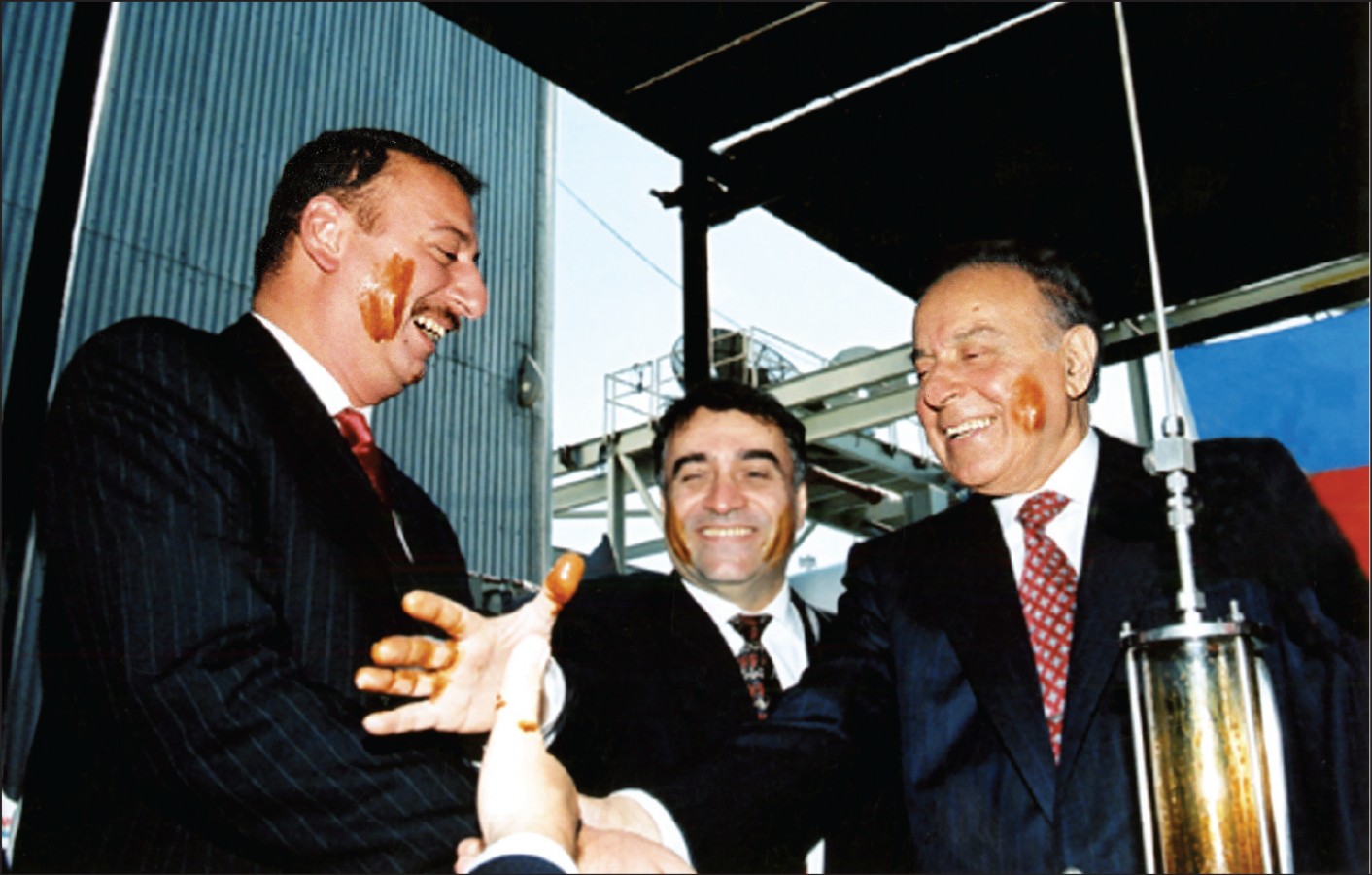
The first oil under the “Contract of the Century” was extracted from the “Chirag” field in November 1997. After this, alternative routes were created for the export of Azerbaijani oil to the world market.
In 1998, oil began to be exported via the Baku–Novorossiysk pipeline, and in 1999, via the Baku–Supsa pipeline. Thus, five years after the signing of the contract, Azerbaijani oil was already being exported to world markets via two directions.
In December 1999, the first tanker filled with Azerbaijan's profit oil was sent to the world market. On December 29 of the same year, the State Oil Fund of the Republic of Azerbaijan was established to collect and manage oil revenues.
The economic transformation created by the “Contract of the Century” gained even greater scale in subsequent years.
While Azerbaijan's nominal gross domestic product was 1.19 billion dollars in 1994, in 2025, the country produced a GDP of 129.1 billion manats. At the current official exchange rate, this is approximately 75.9 billion dollars.
Thus, Azerbaijan's nominal economy in dollar terms has grown approximately 64 times compared to 1994.
In 2025, the country's economy grew by 1.4 percent compared to the previous year. GDP per capita reached 12,602 manats, or approximately 7,413 dollars. In 1994, this indicator was only 157 dollars.
Economic growth continued in January-August 2026, and GDP production increased by another 1.2 percent.
One of the important results of the “Contract of the Century” was the establishment of the State Oil Fund of the Republic of Azerbaijan, which serves to collect and manage oil revenues for future generations.
The assets of the Fund, established in 1999, reached 73 billion 541.5 million dollars at the end of 2025. This is approximately 62 times more than the dollar value of Azerbaijan's entire economy in 1994.
In 2025 alone, the State Oil Fund's revenues from the implementation of oil and gas agreements amounted to 10 billion 266.3 million manats. Of this, 8 billion 292.9 million manats came from the “Azeri-Chirag-Gunashli” fields.
Oil revenues in past years have been directed to financing the state budget, renewing infrastructure, improving living conditions for internally displaced persons, and implementing educational and other social projects.

When the “Contract of the Century” was signed, the recoverable oil reserves of the “Azeri-Chirag-Gunashli” fields were estimated at 511 million tons. As a result of subsequent exploration and appraisal work, the volume of reserves was further increased.
From the commissioning of the “Azeri-Chirag-Gunashli” and “Shah Deniz” fields until January 1, 2026, approximately 670.3 million tons of oil, including gas condensate, and 508.6 billion cubic meters of natural gas were produced here.
In 2025, 27.7 million tons of oil, including gas condensate, were produced across the country. Of this, 16.2 million tons came from the “Azeri-Chirag-Gunashli” field block.
According to BP, the average daily production in ACG in 2025 was 330 thousand barrels. Throughout the year, a total of 120 million barrels, or approximately 16 million tons, of oil were extracted from the field block.
The “Contract of the Century”, in addition to increasing oil production, transformed Azerbaijan into an energy hub connecting the Caspian basin with world markets.
In the early years, the Baku–Novorossiysk and Baku–Supsa pipelines were put into operation. Later, the Baku–Tbilisi–Ceyhan main export oil pipeline, the Baku–Tbilisi–Erzurum gas pipeline, and the Southern Gas Corridor were realized.
Thus, the contract that brought together the world's leading energy companies in Baku in 1994 shaped Azerbaijan's position in international energy security in the following decades.
 Results of 32 years
In 1994, the Azerbaijani economy shrank by 19.7 percent, hyperinflation prevailed in the country, and the volume of direct foreign investment was only 22 million dollars.
In the first five years, the economy shifted from decline to growth, foreign investment increased 23-fold, and oil production rose by 44 percent. In subsequent decades, Azerbaijan's GDP reached 129.1 billion manats, and the State Oil Fund's assets reached 73.5 billion dollars.
It would not be correct to explain all these results with just one contract. Economic reforms, state policy, world oil prices, and subsequent energy projects also played a significant role in development.
However, the starting point of these processes was the signatures made at the Gulustan Palace on September 20, 1994. The “Contract of the Century” evolved from an agreement on the development of oil fields into a historical document that determined Azerbaijan's economic and geopolitical development path.