The statements made by Armenian Prime Minister Nikol Pashinyan during his recent visit to Russia overturned everything he had said about Russia until now. It is true that all societies now have a serious problem with memory. Otherwise, why would his previous promises in Armenia be questioned?
Pashinyan has been one of the most discussed political figures in the region for years. It doesn't matter if it's positive or negative, the main thing is that he is on the agenda. One of the main questions about his activities is formulated as follows: Is Pashinyan actually pro-Western, pro-Russian, or a carrier of a third line maneuvering between both directions?
It is difficult to give a definitive answer to this question. Because Pashinyan's political behavior is characterized more by situational changes in positions, tactical maneuvers, and image management than by a stable ideological line.
The influence of the school of Armenia's first president, Levon Ter-Petrosyan, on Pashinyan's political formation is undeniable. Pashinyan, who grew up in Ter-Petrosyan's political circle for many years, later entered into a serious conflict with him and did not shy away from open criticism, and even insulting expressions. This fact is an important example showing that political situations and interests prevail over personal loyalty in his political relations.
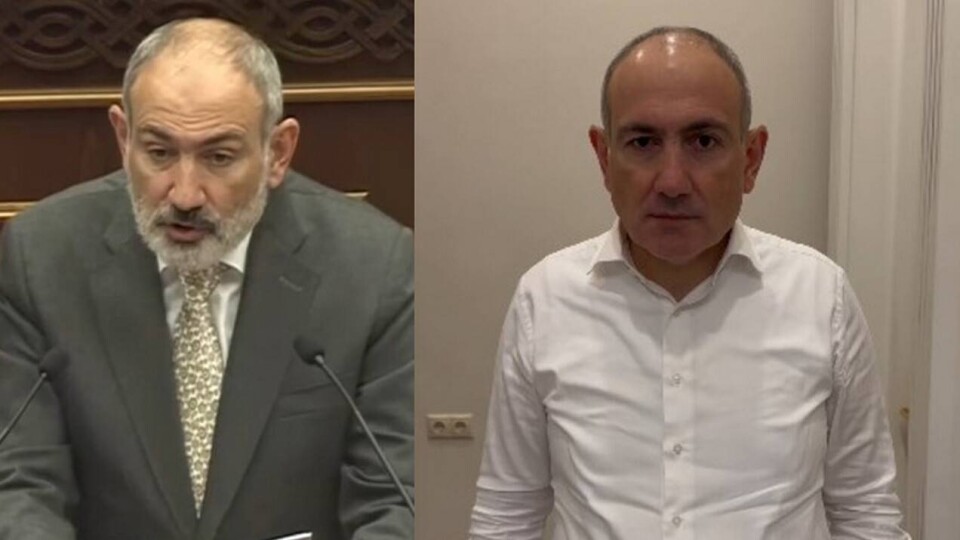
Pro-Western image and compliments to Moscow
After the 2018 “Velvet Revolution,” Pashinyan was mainly presented as a pro-Western politician in the international arena. Rapprochement with the US and the European Union seemed to be the main direction of his political course. However, after being elected prime minister, he showered Russia with compliments, emphasized strategic partnership with Moscow, and declared that Armenia would remain in the Russian security system.
Interestingly, Pashinyan's recent behavior also shows the variability of his geopolitical course. During his last visit to Russia, he sent quite warm messages about the future of relations with Moscow. Pashinyan stated during his last visit to Russia that "we are determined to develop our relations with Russia both before and after the June 7 elections. Of course, we are also interested in continuing our participation in the Eurasian Economic Union."
Later, he again stated that Armenia's main political course is membership in the European Union.
This variability shows that he is dependent on geopolitical circumstances and personal political interests. The main characteristic of Pashinyan's political behavior is his ability to create different images for different audiences. As a result of this approach, he gives a contradictory impression on many issues: He forms an image of an open pacifist, but internally he can be considered a carrier of revanchist tendencies.
He builds an image of an open democrat, but his critics accuse him of hidden authoritarian tendencies. He sends open pro-Western messages, but returns to pro-Russian rhetoric at decisive moments. In this regard, Pashinyan's political line sometimes appears as "unknown politics." He may display a completely different ideological position tomorrow for the sake of personal and geopolitical interests, and the possibility of him adopting a staunch communist, devout Muslim, or another political-religious image is not excluded. All this suggests that Pashinyan is not a naive politician. On the contrary, he can be considered one of the strongest political PR managers in the region under a mask. He has chosen a certain image for himself and has managed to manipulate both the domestic audience and the international community to some extent through this image. One of his main advantages is to deliver messages that meet the expectations of different audiences. This is why Pashinyan is presented on the one hand as a democratic reformer in the West, on the other hand as a pragmatic partner in Russia, and internally as a leader who protects national interests.
To understand Pashinyan's political tactics, it is also necessary to pay attention to the results of the last elections. He garnered almost 50 percent of the votes in the elections and strengthened his power. However, according to some observers, he could have garnered more votes. In this context, it is suggested that if Pashinyan had obtained a higher number of votes and more deputies needed for constitutional changes, this could have limited his future political maneuvering capabilities.Because having a strong enough parliamentary majority for constitutional change would force him to take on more concrete obligations. Therefore, it is claimed that Pashinyan tends to prolong the process as much as possible regarding the issue of referendum and constitutional change.
With this approach, he tries to maintain an Armenian nationalist position internally and prefers to artificially prolong the process to take advantage of new opportunities when geopolitical circumstances change. Today, some consider Pashinyan a man of the West, while others believe that he cannot completely distance himself from Russia. However, the political behavior of recent years shows that he does not give the impression of a leader who follows a consistent political line of either the West or Russia. A more accurate assessment might be that Pashinyan's main political ideology is to protect his personal power, take a position in line with changing geopolitical realities, and keep maximum room for maneuver open. This is why it is difficult to give a definitive answer to the question, "Which sect does Pashinyan serve?"
The only unchanging aspect is his political flexibility, his ability to build an image, and his attempt to maintain the ability to change positions according to the situation. This makes him one of the most unpredictable figures in regional politics.