Against the backdrop of closing the war page in the South Caucasus, initialing the text of the peace agreement between Azerbaijan and Armenia, and the formation of a new political reality in the region, another important trend in Armenia's foreign policy draws attention: as Yerevan moves away from Russia as a security guarantor, it continues to search for new partners that can fill its place.
This process actually accelerated after the 44-day Patriotic War. In 2020, Armenia, which suffered a heavy defeat in the war, realized that the previous military-political model - continuing its occupation policy under Russia's security umbrella - was no longer as effective as before. After the local anti-terrorist measures in September 2023, the final resolution of the Karabakh issue within the framework of Azerbaijan's territorial integrity virtually eliminated the old status quo in the region. After this, Yerevan had two choices: either to reconcile with the new regional reality and move towards peace and neighborly relations with Azerbaijan, or to fill Russia's place in the security system with new actors.
Armenia actively tested the second path as well. In the first stage, France seemed particularly active in this role. Paris increased its political support for Yerevan, military cooperation expanded, and the sale of French-made weapons to Armenia came to the agenda. However, the activity of Azerbaijani diplomacy, the new geopolitical reality in the region, and the progress of the peace process between Baku and Yerevan limited France's maneuvering capabilities in the South Caucasus.
Today, one of the countries rapidly emerging among Armenia's security partners is India. The military component of India-Armenia relations has expanded rapidly in recent years. After 2020, the total value of military equipment purchased and ordered by Yerevan from India is estimated at close to 2 billion dollars in various calculations. In 2022-2024, India became the main source of Armenia's arms imports, and according to some studies, India accounted for 43 percent of Armenia's arms imports during this period.
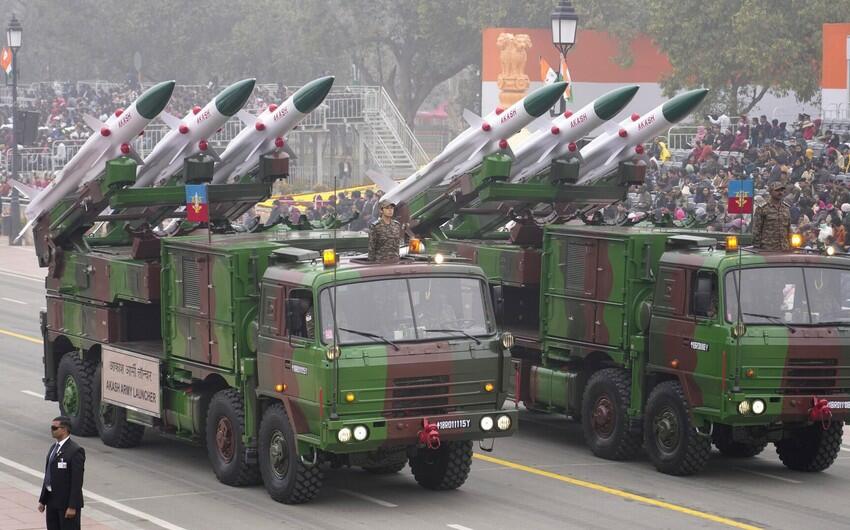
This is more than ordinary military-technical cooperation. Yerevan is acquiring Akash-1S air defense systems, Pinaka multi-barrel rocket launchers, ATAGS 155 mm howitzers, Swathi counter-battery radars, MArG self-propelled artillery systems, Trajan howitzers, and anti-drone systems from India.
One of the most notable contracts is related to the Akash system. Armenia became the first foreign buyer of India's Akash air defense system in 2022. The value of the agreement is estimated at approximately 720 million dollars. The system is designed for use against aircraft, drones, and other air threats.
Another important weapon system is Pinaka. Armenia signed a contract for four batteries of Pinaka multi-barrel rocket launcher systems in 2022. The system is designed for high-intensity artillery strikes and is of particular importance for Yerevan given the characteristics of the Azerbaijan-Armenia border. In early 2026, India also sent the first batch of guided Pinaka missiles for Armenia.
ATAGS is a modern 155 mm towed artillery system. Armenia was one of the first foreign users of this weapon. In addition, India's Swathi radars are used to identify the firing positions of enemy artillery. The demonstration of ATAGS, Pinaka, Swathi, MArG, and other Indian-made systems in Armenia in 2026 showed that cooperation is no longer on paper, but at the level of real military capabilities.
The scale of this cooperation is not accidental. India itself has been trying to strengthen its position among the world's leading arms exporters in recent years. India's defense exports are reported to have exceeded 4.1 billion dollars in the 2025-2026 fiscal year, and Armenia is one of the main destinations for these exports.
The economic factor is also not insignificant here. India is expanding cooperation with Armenia not only in the military field but also in trade, logistics, customs, and connectivity issues. The Indian government has approved the signing of an agreement on customs cooperation and mutual assistance with Armenia. One of the goals is to facilitate trade and exchange customs information.
For India, Armenia is also interesting as a geopolitical foothold in the South Caucasus and in terms of alternative connections towards Europe. It is openly written in India's strategic circles that Armenia is considered a balancing element against Azerbaijan-Turkey-Pakistan cooperation.
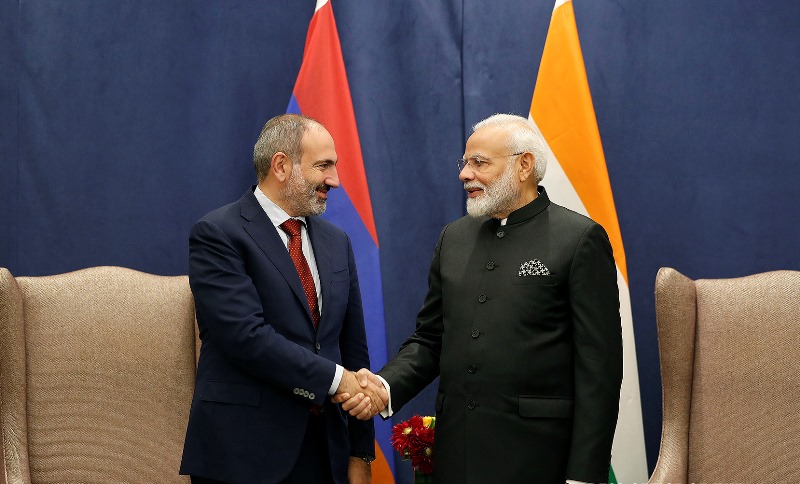
In this regard, recent events are also noteworthy. India's Defense Minister, Rajnath Singh, arrived in Yerevan on August 16. This visit takes place against the backdrop of further deepening defense cooperation between the two countries. Contacts between Armenia's military leadership and India have also intensified: in April, the Chief of the General Staff of the Armenian Armed Forces, Eduard Asryan, held high-level meetings in India, where the parties discussed training, modernization, and expansion of military cooperation.
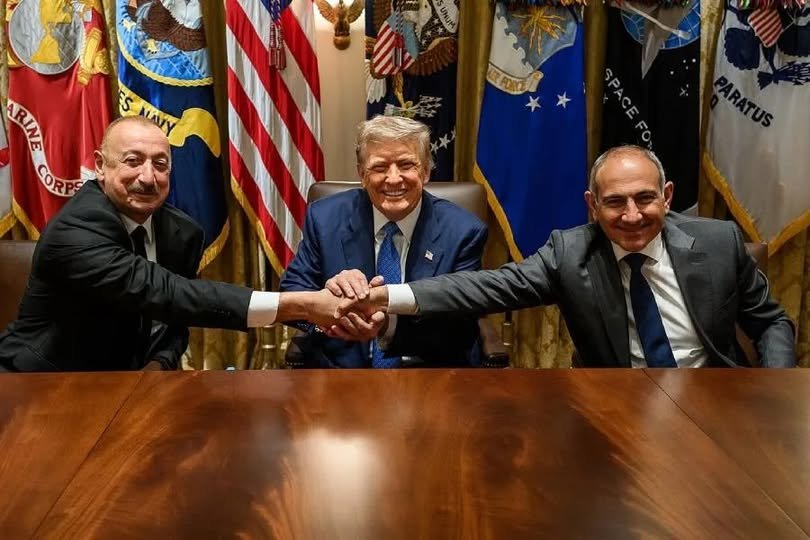
What does armament mean against the backdrop of the peace process? This is precisely the main question. Because on August 8, 2025, the agreed text of the peace agreement between Azerbaijan and Armenia was initialed in Washington. The parties also declared the importance of taking additional steps for final signing and ratification. In August 2026, Baku, Yerevan, and Washington reaffirmed their commitment to the implementation of the peace agreements. At such a stage, Armenia's continued large-scale new arms purchases naturally raise questions.
Of course, every state has the right to increase its self-defense capabilities. However, in a region like the South Caucasus, which has experienced conflict for many years, the acquisition of large volumes of offensive and defensive weapons can create security concerns for the other side. Especially, a state outside the region like India, but with complex geopolitical confrontations with Azerbaijan due to the Pakistan issue, taking a larger role in the military balance of the South Caucasus creates additional risks.
Certain contradictions have also been observed in India's relations with Azerbaijan in recent years. New Delhi particularly takes into account the Pakistan factor in its position regarding Baku. This has been evaluated as one of the indicators of New Delhi's transition to a tougher and militarily stronger policy in its relations with Pakistan. When evaluating New Delhi's policy in the South Caucasus, changes in India's internal political model should also not be overlooked.
The BJP government led by Prime Minister Narendra Modi has been accused of pursuing a tougher policy related to Hindu nationalism in recent years. Human Rights Watch has expressed concern about discrimination against Muslim minorities in India, demolition of homes and properties without legal procedure, violence against religious minorities, and practices called